
Company History

The History of Miki Co Ltd

The Relentless Pursuit Since 1924
What began in 1924 in the city of Tomioka has evolved into an uncompromising devotion to cue craftsmanship.
Trace the journey of Miki Company from our local roots to a globally recognized brand and discover the spirit of innovation that continues to shape our craft today.

Part 1: Pre-Foundation ~ Early History (1924–1958)

The Origins in Tomioka: A Heritage Forged in the City of Silk

The narrative of Miki Company begins in 1924, in the heart of Tomioka City, Gunma Prefecture. When founder Fukujiro Miki first dedicated himself to the art of woodcraft, he set in motion a century-long legacy of precision manufacturing.

Tomioka City, now home to a World Heritage Site, had flourished as an international epicentre of the silk trade since the 1870s. It was within this vibrant, globally connected environment that Fukujiro embarked on his path as an artisan. Through diverse and demanding projects—ranging from xylophone mallets to intricate wooden ornaments for festival floats—he cultivated a profound understanding of materials and an unwavering mastery of technique.

The Pursuit of Precision: The Shuttle Bobbin Milestone

In the post-war era, Fukujiro directed his expertise toward crafting wooden shuttle bobbins for industrial looms. His exceptional ability to read the wood’s grain and produce flawless components, entirely free from warping or distortion, earned him high praise from his customers.

The uncompromising ethos and technical mastery left by this quietly dedicated craftsman laid the very foundation of Miki Company. The open, international perspective nurtured in Tomioka, combined with a relentless pursuit of quality, became the guiding philosophy of an enterprise destined for the global stage.

Part 2: Foundation (1959–1965)

A Fateful Encounter: Artistry from a Single Piece of Wood

In 1958, Yuji Miki embarked on an apprenticeship at the Takahashi Woodwork Factory in Tokyo, seeking to inherit and elevate his father Fukujiro’s craft. There, he observed artisans meticulously hand-shaping heavy timber into elegant, flowing curves. It was during this period that he discovered the one-piece billiard cue—a revelation of precision carved from a single piece of wood. This singular encounter would ultimately define the future of Miki Company.

After nine months of rigorous training, Yuji returned to Tomioka in 1959 to manage the workshop alongside his father. Driven to marry traditional craftsmanship with mechanical consistency, he engineered a specialized lathe. Following six months of relentless trial and error, his prototype cue achieved the exacting standards required, securing a monumental order of 500 cues per month from his former mentor.

Expansion in Nanokaichi and the Dawn of a New Era
AERIAL VIEW OF TOMIOKA CITY CIRCA 1960s

To accommodate growing demand, the Miki’s relocated in 1964 to an expansive 18,000 square feet site in Nanokaichi, Tomioka City. The company grew to a dedicated team of ten, producing 2,000 cues monthly. Yet, the year also brought profound adversity: the sudden bankruptcy of their sole client, followed by the tragic passing of Fukujiro Miki at the age of 61.
Undeterred by these trials, Yuji forged ahead. On February 25, 1965, he formally established Miki Woodwork Manufacturing Co., Ltd. Around this time, the visionary craftsman learned of the “two-piece cue”—an innovative design featuring a metallic joint connecting the shaft and butt. Recognizing its potential, he immediately dispatched his young apprentice, Noriyuki Yoshida, to Yokohama to study this discovery and master the techniques required for its creation. The journey to becoming a premier cue manufacturer had truly begun.

AERIAL VIEW OF TOMIOKA CITY CIRCA 1960s

Part 3: Global Expansion (1965–1969)

Gateway to the World: Scaling New Heights
1939 HITACHI MOTOR THAT WAS USED FOR PRODUCING ONE PIECE CUES

Faced with the loss of his domestic clientele, Yuji looked beyond Japan’s borders. In 1965, he began exporting one-piece cues through the Kyohoku Shokai trading company—a strategic pivot that would forever alter the company’s trajectory.

International demand surged, propelling production to an astounding 20,000 units per month. As the workforce expanded and the factory grew to 25,000 square feet, Yuji instituted a revolutionary philosophy: uncompromised, reproducible excellence. He vigorously pursued the mechanization of complex craftsmanship, establishing a rigorous quality control system that relied on systematic precision rather than individual variance. This framework became the cornerstone of Miki’s ability to compete on the global market.

An Encounter Across the Pacific

Among the prominent recipients of these exports was David Forman, a visionary billiard equipment dealer based in New York. Captivated by the flawless precision of Japanese woodworking, Forman conceived a bold idea: to achieve American-standard billiard quality utilizing Japanese manufacturing prowess.

This was not merely a commercial alliance; it was the prelude to a historic convergence of American cue-making ingenuity and Japanese artisanal exactitude.

1939 HITACHI MOTOR THAT WAS USED FOR PRODUCING ONE PIECE CUES

Part 4: Technological Innovation (1969–1971)

A Cross-Cultural Innovation Taking Root
1997 BCA EXPO - DAVID FORMAN PAYS A VISIT TO THE MEZZ BOOTH
In 1968, David Forman co-founded Regal Cue Manufacturing Co., Ltd. in Saitama Prefecture, bringing in American master craftsman Dick Helmstetter to oversee Japan’s first authentic two-piece cue production. Although this initial venture faced insurmountable financial challenges by 1969, Forman’s vision remained undimmed.

In March 1970, Forman established Adam Custom Cues Japan Co., Ltd., appointing Helmstetter as president to begin the challenge anew. To realize their ambitions for expanded production, they required a partner of unparalleled skill. They chose Miki Woodwork Manufacturing.
Miki Company: Flight Toward the Future
YUJI MIKI AND RICHARD C HELMSTETTER
The rationale behind the partnership was clear. Miki’s intimate knowledge of two-piece cues, coupled with their ability to deliver unwavering precision through mechanized craftsmanship, perfectly aligned with exacting American standards.

On April 25, 1970, the enterprise was reborn as “Miki Company”—a name reflecting a bold readiness to transcend the traditional boundaries of woodworking. The following year, on October 1, 1971, a formal manufacturing contract was signed with Adam Custom Cues Japan.

With a dedicated workforce of 20 artisans, the full-scale production of American-standard two-piece cues commenced. It marked the dawn of a new era, beautifully marrying Japanese technical mastery with American design philosophy.
1997 BCA EXPO - DAVID FORMAN PAYS A VISIT TO THE MEZZ BOOTH
YUJI MIKI AND RICHARD C HELMSTETTER

Part 5: The Era of Contract Manufacturing (1971–1979)

The Invisible Giant: Supporting the Global Stage
A SELECTION OF MIKI COMPANY PRODUCED CUES
In 1971, Miki Company commenced OEM (Original Equipment Manufacturer) production for Adam Custom Cues Japan. Bearing the “ADAM” marque, these cues reached the global market through David Forman’s expansive distribution network, guided by Dick Helmstetter’s cutting-edge technical insights. While the Miki name remained hidden from the public eye, their uncompromising quality exponentially elevated the standard of Japanese cue manufacturing.

Following the “Nixon Shock” of 1971, the rapid appreciation of the yen plunged countless export enterprises into profound crisis. Yet, Miki Company endured. Their superlative technical mastery—capable of flawlessly executing Helmstetter’s demanding requirements for advanced inlay techniques and intricate engravings—ensured a relentless influx of orders when others faltered.
Mastering Three Continents: A Production Prowess of 2,000 Cues
CLASSIC CATALOGUES FROM MIKI COMPANY'S OEM ERA
During the mid-1970s, Miki’s manufacturing repertoire expanded dramatically. Crafting pocket cues for the Americas, carom cues for Europe, and snooker cues for the United Kingdom, they masterfully answered the distinct specifications and demands of disparate global markets, dispatching 2,000 finished cues worldwide every single month.

Adam, Helmstetter, Brunswick, Longoni, Riley—dozens of prestigious brand names graced the cues born within the Miki craftsmen. Players across the globe likely never realized their instruments were crafted in Japan. Yet, undeniably, Miki Company had become the invisible giant quietly sustaining the international world of billiards.
A SELECTION OF MIKI COMPANY PRODUCED CUES
CLASSIC CATALOGUES FROM MIKI COMPANY'S OEM ERA

Part 6: Trials and Transformation (1980–1994)

The Headwinds of the Yen, and a Sudden Ray of Light
THE POOL BOOM IN JAPAN WAS MAINLY BROUGHT ON BY THE FILM THE COLOR ON MONEY
As the 1980s dawned, the popularity of billiards in America began to wane. Following the Plaza Accord of 1985, the yen surged to the 150-to-the-dollar range, rapidly eroding the export viability of Japanese-made cues. By 1986, Adam Custom Cues Japan transitioned to a limited company, Helmstetter returned to the United States, and orders to Miki dwindled. A severe winter had arrived.

However, in 1987, the winds abruptly shifted. The release of the film The Color of Money and the advent of “pool bars” ignited an unprecedented billiards boom across Japan. Demand for billiard tables and cues exploded overnight.
Innovation Amidst Constraint
ONE OF THE FIRST CNC MACHINES USED AT THE MIKI FACTORY
Despite the surging domestic market, Miki was contractually bound to supply only Adam. To adapt, they pivoted to manufacturing the wooden rail frames for billiard tables. Introducing state-of-the-art NC (Numerical Control) machinery, Noriyuki Yoshida—now the factory manager—mastered the programming entirely from scratch. This technological leap enabled the creation of vastly more complex inlay designs.

Yet, Miki’s proposals for original cue designs were rejected by their client; they were permitted only to manufacture standard, mass-market models. The constraints of the OEM relationship had become a heavy shackle.
A Critical Juncture and the Long Winter
CUES ON DISPLAY WITH NON BILLIARDS PRODUCTS AT A LOCAL TRADE SHOW
In 1988, a critical turning point emerged regarding the company’s management direction. Divergent perspectives arose from both sides concerning the continuation of cooperation (Miki & Adam). During this period, Miki undertook careful deliberation about its future business development, and found itself unable to accept strategic directions that diverged from its own corporate philosophy, thus proceeding to reconsider its contractual arrangements. Subsequently, with the termination of the contract, Miki embarked upon the path of an independent cue maker.

Yet freedom carried with it a significant price.

Even after the conclusion of the contract, direct transactions with overseas buyers and domestic distributors did not materialize. The company continued to rely on orders from Adam for several years. In 1991, the billiards boom subsided. Miki found itself maintaining operations through the manufacture of furniture components and shamisen instruments, entering a prolonged period of hardship that would test the company’s resilience and determination.
THE POOL BOOM IN JAPAN WAS MAINLY BROUGHT ON BY THE FILM THE COLOR ON MONEY
ONE OF THE FIRST CNC MACHINES USED AT THE MIKI FACTORY
CUES ON DISPLAY WITH NON BILLIARDS PRODUCTS AT A LOCAL TRADE SHOW

Part 7: The Birth of a House Brand (1994–1999)

A Successor’s Resolve: The Dawn of a New Era
“MAJESTICA” THE FIRST IN HOUSE BRAND OF MIKI
Born in 1966, Kazunori Miki grew up in the family home adjacent to the Nanokaichi factory, his childhood steeped in the sounds and scents of fine woodworking.

During his university years, amidst the height of the billiards boom, a part-time role in cue design crystallized a silent resolve within him: “To sell to the world under our own brand name.” Keeping this ambition to himself, he departed for London in 1988 to study.

After mastering English and gaining vital experience in international trade, Kazunori officially joined Miki Company in April 1994. His reforms were swift and decisive. By establishing direct contracts with European distributors, he dramatically improved the company’s profit margins.

Then, in July 1995, he launched the long-awaited in-house brand: Majestica. Named for its inherent “majesty,” the brand debuted with the MF and MB series, alongside the premium SP-1 model. Kazunori spearheaded the design, while Yuji and Yoshida oversaw the meticulous manufacturing.
The Trial of Obscurity and the Awakening of Originality
THE INTRODUCTION MEZZ BRAND IN THE 1995 BCA EXPO
The reality of the market, however, was unforgiving. Despite Kazunori and Yoshida traveling across Japan to present their creations to billiard halls, the response was tepid.

To Japanese players, Majestica was merely an unproven, newly emerged manufacturer. No one knew of the 35 years of masterful history behind the wood. In August 1995, seeking to break into the overseas market, they attended the BCA Trade Expo in Las Vegas, Nevada.

They arrived bearing a new, concise, and memorable brand name: Mezz—derived from the ancient Japanese word “愛づ – mezu”, meaning “to love or cherish.” Yet, facing a punishing exchange rate of 90 yen to the dollar and the impenetrable wall of obscurity, negotiations stalled. History and quality alone were not enough to sell a cue.
Breakthrough Through Innovation
EARLY MEZZ CATALOGUES AND BROCHURES

“To be recognized by the market, we must possess absolute originality,” Miki realized. Over the next year, they poured their expertise into developing the UN series, unveiling it at the July 1996 Expo. This revolutionary lineup featured six models equipped with the patented United Joint, an elongated butt-end cap, the pioneering layered Moori Tip, and the BRC break cue.

The innovations of Mezz captivated American distributors, resulting in the realization of long-sought agency contracts. As news of these “overseas exclusive” cues filtered back to Japan, domestic demand skyrocketed.

Following the release of the SD and SG series, and an expanded UJ line in 1997, the Mezz name achieved rapid prominence. In 1999, the Majestica line was retired, establishing Mezz as the House’s unified global brand. The invisible giant had finally stepped into the light, bearing its own name.

“MAJESTICA” THE FIRST IN HOUSE BRAND OF MIKI
THE INTRODUCTION MEZZ BRAND IN THE 1995 BCA EXPO
EARLY MEZZ CATALOGUES AND BROCHURES

Part 8: The Era of the Scientific Approach and Collaboration (1997–2002)

Partnering with Professionals: The Genesis of the Scientific Approach
ONE OF THE KEY PILLARS OF MIKI’S INNOVATION: CUE MASTER
In 1996, Miki signed the brilliant young professional Kunihiko Takahashi. Armed with the first professional model, the TA-1, Takahashi went on to conquer the Japan Open, the All Japan Championship, and the World 9-Ball Championship. His precise feedback regarding cue characteristics proved invaluable in refining Mezz’s performance, paving the way for future partnerships with the world’s elite players.

At the 1995 BCA Trade Expo, Kazunori encountered Allan McCarty of Predator Cues. Predator’s 314 Shaft—featuring laminated maple and front-end mass reduction—was a radical, scientifically driven anomaly in an era dominated by the supremacy of solid wood shafts.

Profoundly inspired by this methodology, Miki developed their own proprietary robotic testing machine, the Cue Master I, in March 1999. Capable of replicating strokes with exact consistency in impact point and force, the machine allowed Miki to gather objective data on deflection, squirt, and spin. They were among the very few manufacturers worldwide to engage in such advanced research. By July 2000, this technology evolved into the Cue Master II. The resulting two years of rigorous data accumulation would soon give birth to a revolutionary breakthrough: the Hybrid Shaft.
A New Horizon of Collaboration
KAZUNORI MIKI WITH KARIM BELHAJ
As diverse cue manufacturers emerged throughout the 1990s, Miki actively forged alliances with makers possessing technologies they did not. In September 1999, they secured the exclusive Japanese agency rights for Cuetec, a company renowned for its proprietary clear-fiber resin technology. That same year, a collaborative brand—designed by Miki and manufactured by Cuetec—was launched as Focus (later rebranded as Zesty in 2001), equipped with Miki-crafted spare shafts.

In 2000, Miki designed for another manufacturer to release the Rage and Fury lines. Furthermore, beginning in November 2000, the Nanokaichi factory began performing joint installations on Predator 314 partial shafts, offering them as an option for Mezz cues. This collaboration deepened to the point where Miki supplied original butt designs to Predator, proudly bearing the inscriptions “by Mezz” and “by K. Miki.” The landscape had entirely transformed from their days as an anonymous OEM.
The Fruition of Technological Innovation
SPECIFICATIONS, TECHNICAL DRAWINGS AND PATENTS OF MIKI
At the dawn of the 2000s, Miki unveiled a rapid succession of masterworks: the maple-straight BS and BC series, the globally limited 200-piece LE2000, the House’s first dedicated jump cue, the JC, and the refined PUJ series. Then, in August 2000, the two years of relentless research utilizing the Cue Master culminated in the patent application for the Mezz Hybrid Shaft—a groundbreaking design featuring a dual-structure carbon fiber core encased within maple. In July 2001, it was introduced as standard equipment on the limited 100-piece LE2001.

Innovation continued unabated. In 2002, Miki commissioned a materials manufacturer to create a bespoke composite wood (a fusion of wood and synthetic resin), launching the dedicated Power Break cue. Simultaneously, they engineered the Wavy Joint—a proprietary design developed to prevent loosening caused by wood shrinkage over time.

This innovation would take its place alongside the United Joint as a signature Miki system. By 2003, the composite-wood ZZ series was introduced to the domestic market as the CP line, completing the unification of their global portfolio. The invisible giant had unequivocally transformed into the vanguard of industry innovation.
ONE OF THE KEY PILLARS OF MIKI’S INNOVATION: CUE MASTER
KAZUNORI MIKI WITH KARIM BELHAJ
SPECIFICATIONS, TECHNICAL DRAWINGS AND PATENTS OF MIKI

Part 9: The Birth of Exceed and a New Leap Forward (2003–2005)

Beyond the Limits: The Exceed Revolution

In the early 2000s, the allure of high-end custom cues was rising rapidly. To shatter the perception of Mezz as merely a “mass-production manufacturer,” Miki unveiled a prototype for a new series in March 2003. It was christened Exceed—a name embodying Kazunori’s unwavering resolve to surpass all existing limitations.

The inaugural series, released in June of that year, featured the Power Core Butt, a triumph born from three years of development. The realization of this highly complex structure—a core material running through the entirety of the butt—relied entirely on Yoshida’s superlative machining expertise. Initially produced in limited quantities as the Mezz Exceed, the cues featured the letters Mezz EX and Mother-of-Pearl dot inlays on the butt end, accompanied by the refined Hybrid Pro Shaft as standard.

In August 2003, they released the pinnacle LE2003, strictly limited to 25 pieces. Following its trademark registration in 2004, the name was officially changed to simply Exceed. By establishing it as a distinct brand separate from Mezz, Miki carved out a new, elevated horizon in cue making.

Okamoto: The Expanding Stage
OKAMOTO HEADQUARTERS
The surging demand for Exceed and the diverse Mezz portfolio pushed the Nanokaichi factory—operational since 1964—beyond its limits. Despite the monumental investment and the inherent risks of halting production, Yuji and Kazunori made the bold decision to relocate. In December 2003, the new atelier in Okamoto, Tomioka City, commenced operations.

Spanning 53,000 square feet—more than double the size of Nanokaichi—the purpose-built facility housed state-of-the-art machinery and expansive timber reserves. With production capacity and quality exponentially enhanced, Miki easily met the soaring demands of 2004.

They unveiled the Air Shooter jump cue in March, announced the weight-adjustable Power Break II in April (released in January 2006), and introduced the P2 Model, equipped with the advanced Hybrid Pro 2 shaft.
The Iceman: A Bridge to the World
MIKA IMMONEN (1972–2025)
Elevating the House’s international prestige required aligning with the world’s finest. In 2003, in collaboration with US distributor Cuestix, Miki signed a sponsorship agreement with Finnish phenomenon Mika Immonen.

Known globally as “The Iceman,” Immonen would go on to capture a multitude of international titles wielding his signature MI series—from the MI-1 in 2004 and MI-2 in 2006, to the MI-3 in 2009, and the Exceed EXC2-172MI4w/Le.

His extraordinary achievements exponentially elevated Miki’s brand recognition, paving the way for numerous contracts with elite international professionals. His passing in September 2025 at the age of 52 remains a profound and deeply mourned loss to the billiards community.
OKAMOTO HEADQUARTERS
MIKA IMMONEN (1972–2025)

Part 10: Generational Succession and the Challenges of a Premium Product (2005–2010)

A New President, Accelerating Innovation
MEZZ EX “LE2003”

On April 29, 2005, Kazunori Miki formally assumed the mantle of President and Representative Director, with Yuji transitioning to Chairman. A new era had begun. That same month, the House launched the limited-edition HP series, featuring the Hybrid Pro shaft. In September, during an international invitational tournament in Brunei, Kazunori had the profound honor of personally presenting an Exceed LE2003 to the Crown Prince, an avid player himself.

During this period, technological innovation accelerated. In November, the “Deep Impact” break shaft was announced. Simultaneously, the company developed the new “WD700” shaft, which achieved superior performance even at an accessible price point. By incorporating an internal support structure of styrene resin and wood within the front 15 cm of the shaft, it reduced deflection while preserving the natural feel of solid maple wood.

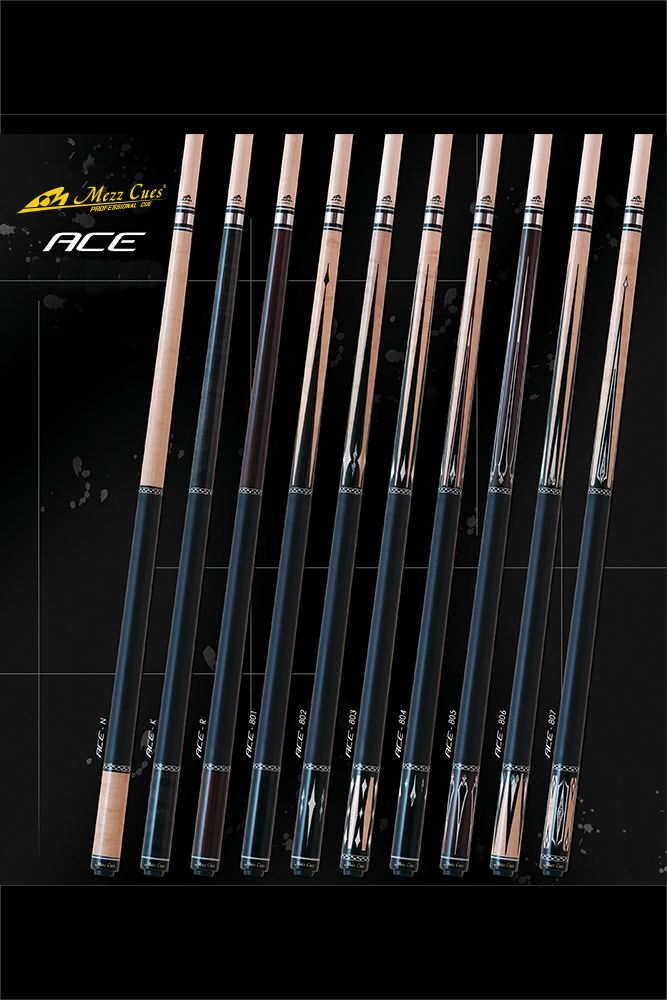
In June 2008, Miki introduced the “Mezz ACE” series, equipped as standard with the “Hybrid Alpha” shaft—an upgraded version of the “Hybrid Pro II.” The following year, in 2009, the company released the break-dedicated “Deep Impact Pro” shaft, incorporating ash wood as a core material to enhance power performance.

ICCS: The Ascent to the Summit
WITH ICCS FOUNDER BILL STROUD AND HIS WIFE (2009)

While the reputations of Mezz and Exceed were soaring, the lingering perception of being a “mass producer” required a definitive challenge to overcome. In 2006, Miki made their inaugural appearance at the International Cue Collectors Show (ICCS) in Las Vegas. This exclusive event represented the absolute pinnacle of the billiards world—a gathering of elite, small-batch custom cue artisans and the globe’s foremost collectors. It was an arena of uncompromising scrutiny, where creations were evaluated directly by peers and connoisseurs.

Miki committed to crafting spectacular, bespoke models for every ICCS event. By standing shoulder-to-shoulder with the world’s most revered bespoke makers—absorbing diverse design philosophies and techniques—Exceed gradually, yet forcefully, penetrated the highest echelons of the luxury market. Through masterpieces such as the Santa Fe Collection EXCS-09SF (presented in Santa Fe, 2009) and the Maritime Collection EXICS-MC10 “Koukai” (presented in Sarasota, 2010), the ICCS exclusive models garnered profound acclaim, solidifying Exceed’s unassailable prestige. As the 2010s dawned, Japanese-crafted Exceed cues were recognized not merely for their peerless quality and aesthetic mastery, but as an indispensable presence at the most prestigious “international” gatherings of the cue-making art.

MEZZ EX “LE2003”
WITH ICCS FOUNDER BILL STROUD AND HIS WIFE (2009)

Part 11: An Era of Diverse Innovation (2010–2015)

Dramatic Expansion of Product Lineup
EXPANDING PRODUCT PORTFOLIO PAST POCKET BILLIARDS

Following the relocation to the Okamoto factory in December 2003, Miki’s research and development accelerated. Entering the 2010s, innovative products were born one after another.

In February 2010, the company released the “EXD-HA2,” a Hayato Hijikata professional model featuring Exceed’s “Dual Power Core” wood grip structure. In May, they announced Mezz’s new break cue, the “Power Break Pro.” In January 2011, Mezz launched the limited-edition “Euro” series, featuring flag motifs from 19 European countries—an innovative endeavor in billiard cue design.

Significant progress was also made on the technical front. Research began on structures allowing players to fine-tune the weight balance of their cues. In April 2010, Miki obtained a patent for a ” Gravity Adjustment Structure of a Cue Center,” followed by another in August for a “Shaft Weight Adjustment System.” These technologies eventually culminated in the “Shaft Weight Bolt” and the Mezz “AVANT,” which enables weight adjustments at both the front and rear of the butt.

On March 11, 2011, the Great East Japan Earthquake struck. Gunma Prefecture recorded a seismic intensity of lower 6, but fortunately, damage to the Okamoto factory was minimal, keeping the impact on development and production to a minimum. Miki provided assistance to members of the billiards community through the Billiard Commercial Association of Japan (BCJ). In April, the “Deep Impact Pro H” break shaft was announced.

In June, the Mezz “MSP” series sneaky pete cues were released, highlighting the natural beauty of wood grain. In September, the Mezz “MA-FK”—the first cue specifically designed for masse shots equipped with a Kevlar shaft—was introduced. In 2012, Miki launched the Alex Pagulayan pro model Mezz “AP-2” alongside four “LE-12” Mezz models, limited to 25 units each. In July 2013, sales began for the “WX900” shaft, an improved version of the “WD700.”

Furthermore, leveraging know-how accumulated from OEM production since the 1970s, Miki expanded beyond pool (pocket billiards). In March 2014, they launched the Mezz “CR” series for carom billiards, followed by the Mezz “SKR” series for snooker in July, solidifying their status as a comprehensive cue manufacturer.

Evolution of Wooden Shafts
THE EX PRO STILL STANDS AS A FAVOURED SHAFT IN THE INDUSTRY

The break shot is a crucial technique that directly influences match outcomes, making break cues a fiercely competitive field among global manufacturers. Miki actively engaged in development by leveraging insights from its contracted professional players in Japan and abroad.

In December 2014, Miki announced the “Power Break Kai.” By redesigning the front end of the shaft and the tip, the “break sweet spot” was enlarged. This achieved both powerful energy transfer to the rack and enhanced cue ball control.

That same month, Exceed’s new hybrid shaft, the “EX Pro” was announced. Featuring the new “EX Front End Technology” tip structure and a newly designed “EX Pro Taper,” it achieved the natural feel of solid maple wood along with superior performance characteristics. Widely embraced by players, it further elevated the appeal of the Exceed brand.

In 2015, two new Mezz series were introduced. In February, the Mezz “CP-13SW” series featuring long-and-short 6-prong points—a standard design in modern cues—was launched, followed by the Mezz “AXI-15” series offering 13 different designs in July. Simultaneously, Miki introduced the “Shaft Weight Bolt,” which allowed weight adjustments ranging from 3g to 10g by inserting weights into the base of the shaft.
EXPANDING PRODUCT PORTFOLIO PAST POCKET BILLIARDS
THE EX PRO STILL STANDS AS A FAVOURED SHAFT IN THE INDUSTRY
To Be Continued…